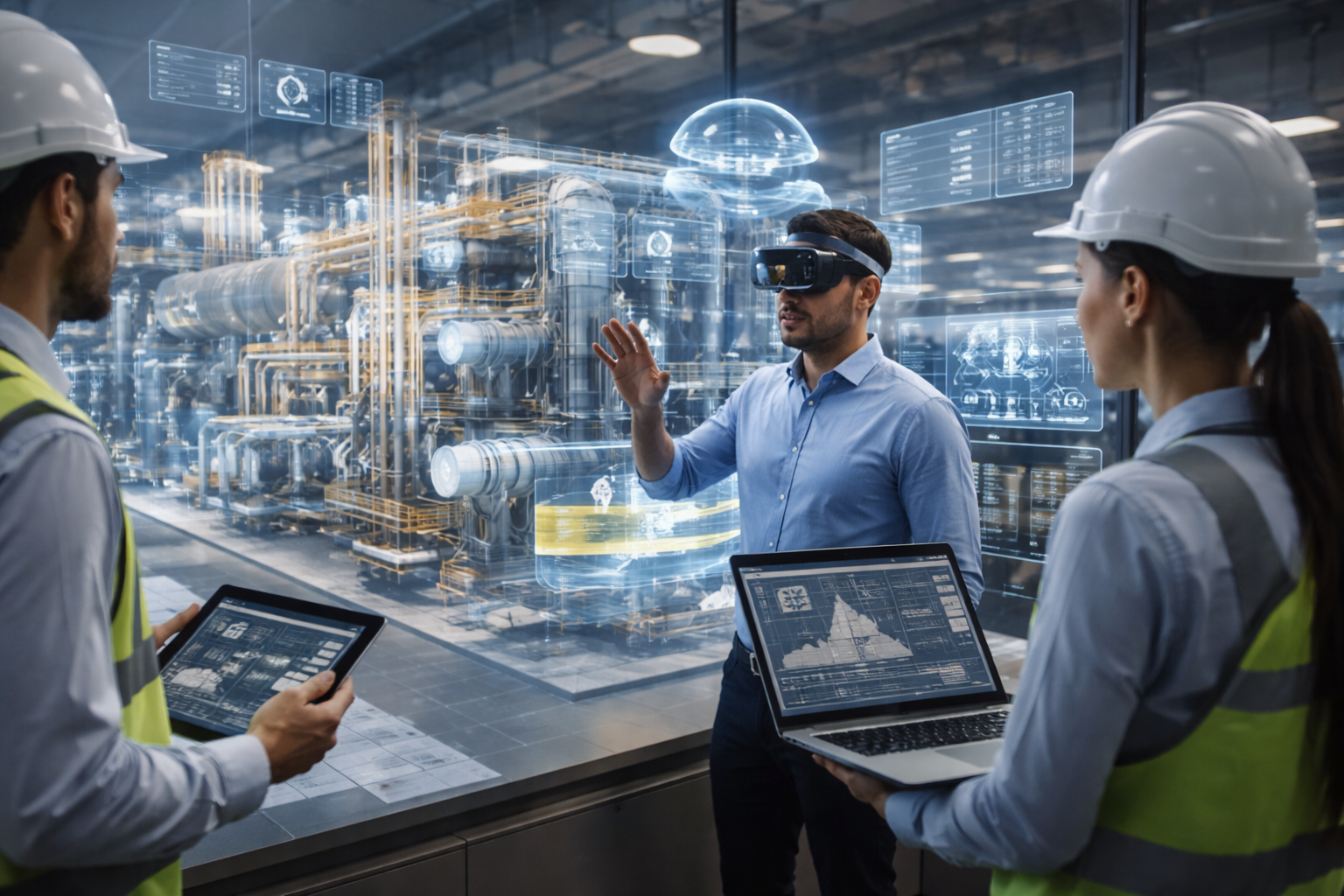
Introduction: Beyond the Hype of the Digital Twin
The term digital twin has evolved from a futuristic buzzword into a central pillar of industrial digital transformation. Despite its widespread use, it remains one of the most misunderstood concepts in modern enterprise technology. Depending on who you ask, a digital twin might describe anything from a basic telemetry dashboard to a fully interactive 3D environment.
For industrial leaders, the definition that truly matters is a functional one. A digital twin is a living digital representation of a physical asset, system, or process that allows teams to visualize, simulate, and optimize operations using real-time and historical data. Its value lies not in appearance, but in its ability to improve understanding and decision-making.
Although the idea of creating physical and digital counterparts dates back to NASA’s engineering practices in the 1960s, Extended Reality (XR) has fundamentally transformed how digital twins are experienced. The shift is from observing data on screens to interacting with it spatially. XR digital twins introduce a human-centered interface that turns complex industrial data into insight that can be intuitively understood and acted upon.
Defining the XR Digital Twin
An XR digital twin is a spatially accurate, interactive representation of a real-world environment such as a mine site, manufacturing facility, or large-scale infrastructure project. It is accessed through Virtual Reality (VR), Augmented Reality (AR), or high-performance web-based 3D experiences.
The XR component is the key differentiator. Traditional digital twins rely heavily on charts, dashboards, or static 3D models that require users to mentally translate information into spatial understanding. XR leverages spatial computing to present information in a way that aligns with how humans naturally perceive space, scale, and movement. In industries where centimeters matter, the ability to walk through a facility, test layouts, or validate clearances before physical execution delivers a significant operational advantage.
The Spectrum of Digital Twins: Where XR Fits
To understand the unique value of XR digital twins, it helps to view them as part of a broader digital twin ecosystem rather than a replacement for existing systems.
1. Data & Diagnostic Twins (The Brain)
Data and diagnostic twins focus on the operational health of assets. They aggregate information from IoT sensors, condition monitoring systems, and analytics platforms to track performance indicators such as vibration, temperature, or throughput. While powerful for predictive maintenance and anomaly detection, these twins often lack spatial context.
XR bridges this gap by embedding live data directly into a spatial environment. A technician wearing AR glasses can see performance metrics overlaid on the exact machine they are inspecting, improving comprehension and reducing diagnostic time.
2. CAD & BIM Twins (The Skeleton)
Computer-Aided Design (CAD) and Building Information Modeling (BIM) systems provide the geometric and engineering foundation of a digital asset. These models represent the structural truth of a facility or machine and are essential during design and construction.
However, CAD and BIM models are often complex and difficult for non-engineers to interpret. XR digital twins simplify and optimize this geometry, making spatial information accessible to operators, safety teams, and decision-makers who need to understand how a space functions rather than how it was engineered.
3. High-Fidelity Game Engine Twins (The Experience)
High-fidelity XR digital twins built on real-time engines such as Unreal or Unity introduce physics simulation, lighting realism, and interactive behavior. This is where simulation and scenario testing truly come to life.
Instead of passively viewing a model, teams can test how a new conveyor layout affects workflow, simulate maintenance access, or rehearse emergency evacuations under realistic conditions. These experiences enable informed decisions before changes are implemented in the physical world.
The Industrial Shift: Why Adoption Is Accelerating Now
The adoption of XR digital twins is accelerating due to a convergence of technological maturity and operational necessity. Several factors are pushing industrial organizations to move beyond traditional interfaces and into spatial environments.
- The Silver Tsunami and Knowledge Transfer: As experienced workers retire, organizations face the loss of decades of tacit knowledge. XR digital twins create a spatial knowledge repository where procedures, insights, and best practices can be preserved and passed on through immersive training.
- Remote Operations and Distributed Teams: Global operations and decentralized workforces require shared understanding across locations. XR digital twins act as a single source of truth, allowing stakeholders from different regions to collaborate inside the same virtual environment in real time.
- Hardware Accessibility and Cloud Delivery: Advances in enterprise-grade headsets, cloud rendering, and high-speed connectivity mean that immersive experiences are now accessible without specialized workstations or complex deployments.
Operational Impact: Mining, Construction, and Beyond
Across industrial sectors, XR digital twins are addressing costly and persistent operational challenges.
- In Construction: Augmented Reality twins allow teams to overlay BIM data directly onto active job sites. This enables early detection of clashes such as services intersecting with structural elements, reducing costly rework and schedule delays.
- In Manufacturing: Virtual Reality twins support rapid iteration of factory layouts and process changes. By validating ergonomics, access paths, and workflows before physical reconfiguration, organizations reduce downtime during retooling.
- In Mining and Energy: XR digital twins enable virtual site inductions and safety training, minimizing the need to transport personnel to remote locations while maintaining high training standards.
Conclusion: The Future Is Spatial
XR digital twins are no longer experimental technologies reserved for innovation labs. They are becoming core operational systems that connect data, space, and people in a single environment.
By translating complex digital information into spatial experiences that humans intuitively understand, XR digital twins enable faster decisions, reduced risk, and more resilient operations. As industries move toward increasingly connected and immersive ecosystems, the strategic question is no longer whether to adopt digital twins, but how quickly they can be made accessible, interactive, and actionable across the entire organization.