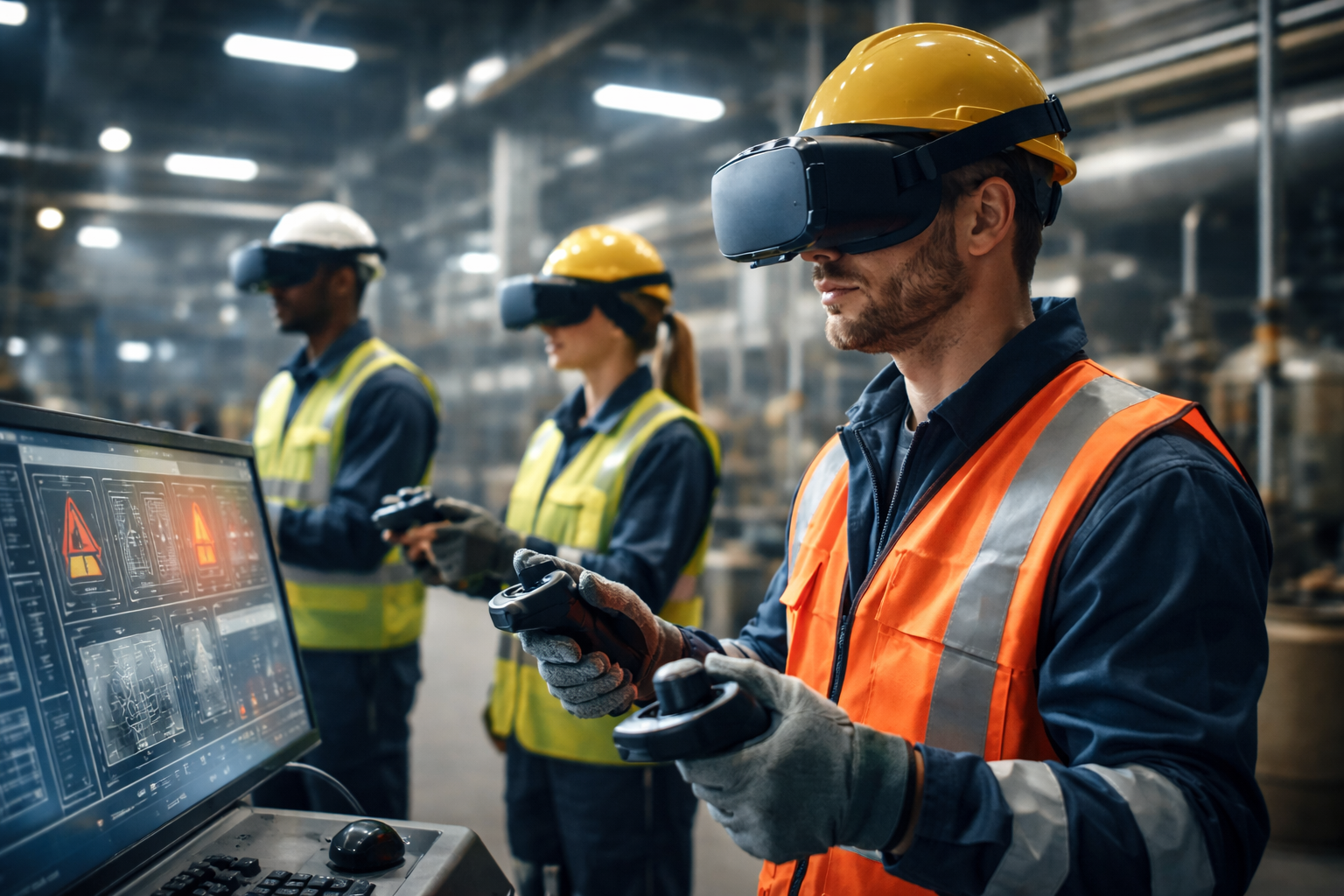
Introduction: What Is Immersive Training?
Immersive training is a learning approach that places people inside realistic, interactive environments where they can practice tasks, procedures, and decision-making as though they were occurring in real-world conditions. Rather than learning about a process abstractly, participants experience it firsthand in a controlled digital setting.
Unlike traditional training methods such as classroom instruction, printed manuals, video tutorials, or job shadowing, immersive training emphasizes experiential learning. Participants do not simply observe or memorize steps. They actively perform tasks, make decisions, and respond to changing situations in real time.
Immersive training relies on technologies such as virtual reality (VR), augmented reality (AR), mixed reality (MR), and interactive 3D simulations to recreate environments, tools, equipment, and potential hazards. This approach allows workers to build familiarity and confidence in complex or dangerous scenarios without putting themselves, their colleagues, or physical assets at risk.
In high-risk industries, immersive training is increasingly recognized as a practical and effective tool for improving safety outcomes, operational readiness, and long-term organizational resilience.
Types of Immersive Training Technologies
Immersive training is not a single technology or delivery method. It is a collection of complementary tools that can be used independently or combined, depending on operational requirements, workforce distribution, and risk exposure.
Virtual Reality (VR) Training
Virtual reality training places users inside a fully simulated digital environment using a VR headset. The physical world is visually blocked out, allowing trainees to focus entirely on the training scenario without external distractions.
VR is particularly effective for high-risk and high-consequence scenarios that cannot be safely or practically recreated in real life. Trainees can operate heavy machinery, navigate hazardous environments, and respond to emergency situations in ways that closely mirror real-world conditions.
VR training is commonly used across industries such as:
- Mining and resources
- Construction and infrastructure
- Manufacturing and heavy industry
- Energy, utilities, and power generation
- Healthcare and emergency services
Augmented Reality (AR) Training
Augmented reality training enhances the physical world by overlaying digital guidance, instructions, and contextual information onto real environments. This is typically delivered through mobile devices, tablets, or AR headsets.
AR is especially valuable for procedural training and real-time task support. Workers can follow step-by-step instructions directly on equipment, view warnings or annotations in context, and verify actions as they work. This reduces reliance on printed manuals and memory while improving accuracy and consistency.
AR training is widely adopted in:
- Field maintenance and inspections
- Manufacturing and assembly operations
- Utilities and infrastructure servicing
- Logistics and warehousing
Mixed Reality (MR) Training
Mixed reality blends digital simulations with physical environments, allowing virtual objects to appear anchored in real-world spaces and interact with physical surroundings.
MR is particularly effective in environments where spatial accuracy and context are critical, such as control rooms, plant floors, and technical installations. Trainees can interact with virtual equipment while maintaining awareness of their real surroundings.
Interactive 3D Web-Based Training
Web-based 3D training delivers immersive learning experiences directly through a standard web browser, without requiring specialized hardware or software installation.
These experiences are commonly used for onboarding, site familiarization, safety induction, and refresher training. They are especially valuable for distributed teams, contractors, or remote stakeholders who need consistent access to training materials.
AI-Driven and Adaptive Training
Artificial intelligence is increasingly being integrated into immersive training systems. AI can introduce scenario variability, monitor performance, adapt difficulty levels, and generate insights into skill gaps and risk patterns.
Over time, AI-driven systems can help organizations identify systemic weaknesses, tailor training to individual needs, and continuously improve training effectiveness.
Why Traditional Training Is Failing High-Risk Industries
Traditional training methods were designed for predictable systems and controlled environments. Modern high-risk industries operate under far greater complexity, tighter timelines, and increased regulatory oversight.
Training for Knowledge, Not Reality
Many conventional programs emphasize procedural knowledge rather than situational application. Workers may understand the steps on paper, but lack experience applying them under pressure, in unfamiliar environments, or during unexpected events.
Inability to Safely Simulate Critical Events
Emergencies, equipment failures, and hazardous incidents are infrequent but carry severe consequences. Traditional training methods cannot safely replicate these scenarios, leaving workers unprepared for the moments that matter most.
Inconsistent Delivery and Skill Gaps
On-the-job training often depends on the availability and experience of individual instructors. This leads to inconsistent delivery, variations in quality, and uneven preparedness across teams and locations.
High Cost of Operational Disruption
Training on live equipment frequently requires shutdowns, reduced production, or removing assets from service. These costs discourage frequent practice and limit opportunities for meaningful repetition.
What Immersive Training Does Differently
Immersive training transforms learning from passive instruction into active participation, allowing workers to build experience before it is required in real-world situations.
Safe Failure and Decision-Making Under Pressure
Trainees can make mistakes, experience realistic consequences, and learn from them without causing real-world harm. This builds confidence and improves decision-making when pressure is high.
Repetition Without Downtime
Scenarios can be practiced repeatedly without shutting down equipment, disrupting operations, or exposing people to danger. This enables mastery through repetition.
Standardization at Scale
Every trainee receives the same high-quality experience regardless of location, instructor, or shift schedule. This consistency improves overall workforce readiness.
Industry-Specific Impact in High-Risk Environments
Mining and Resources
Immersive training allows workers to navigate underground environments, practice emergency evacuations, identify geotechnical hazards, and operate heavy machinery without exposure to real-world danger.
Construction and Infrastructure
Construction teams use immersive training to rehearse complex builds, understand site-specific risks, and improve coordination between trades. This reduces incidents caused by miscommunication or unfamiliarity with evolving site conditions.
Manufacturing and Heavy Industry
In manufacturing environments, immersive training helps operators understand equipment behavior, perform maintenance safely, and respond effectively to failures, minimizing unplanned stoppages and quality issues.
Energy, Utilities, and Power
High-voltage systems, confined spaces, and critical infrastructure demand precise procedures. Immersive training ensures workers are prepared before entering live environments where mistakes carry serious consequences.
Reducing Incidents, Downtime, and Cost
Incidents in high-risk industries generate significant direct and indirect costs, including injury, asset damage, investigations, lost production, regulatory penalties, and reputational harm.
Fewer Incidents Through Better Preparedness
Workers who have experienced high-risk scenarios in immersive environments are more likely to recognize hazards early and respond correctly when similar situations arise.
Faster Recovery When Incidents Occur
When teams know exactly what to do, response times improve, errors decrease, and operations return to normal more quickly.
Return on Investment: Why Immersive Training Makes Business Sense
While immersive training requires an initial investment, the return is realized through fewer incidents, reduced downtime, and more efficient training delivery.
Key ROI drivers include:
- Reduced injury-related costs and compensation claims
- Lower equipment damage and maintenance expenses
- Decreased operational downtime
- Shorter onboarding and ramp-up time
- Improved regulatory compliance
For many organizations, preventing a single major incident can justify the entire investment in immersive training.
Starting Small and Scaling Intentionally
Most organizations begin with a single, high-impact use case such as emergency response training, safety induction, or critical equipment operation.
From there, immersive training can expand into a broader ecosystem that supports onboarding, refresher training, compliance, and ongoing operational readiness.
Conclusion
Immersive training is not about replacing experience or instructors. It is about ensuring people are prepared for situations where experience is difficult, dangerous, or costly to obtain.
For high-risk industries, immersive training has become a practical, scalable, and measurable way to reduce incidents, minimize downtime, and protect both people and operations.