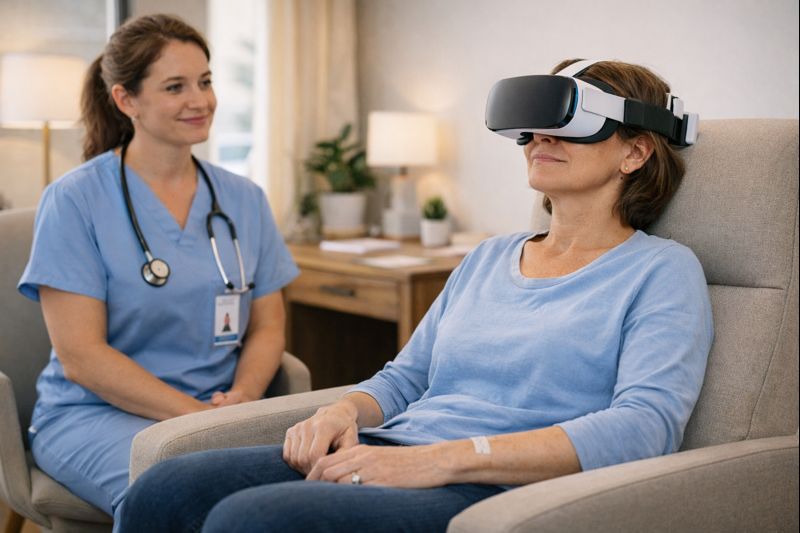
VR for Pain Management & Mental Health
Hospitals and clinics face constant pressure to reduce patient pain, improve overall experience, and minimize medication-related risk. These demands exist alongside limited staff availability and increasing care complexity. Immersive VR therapy is emerging as a practical, non-pharmaceutical tool that helps patients manage acute pain, anxiety, and stress-related symptoms through guided, clinically designed experiences.
This article examines research findings on VR-based therapeutic interventions across healthcare settings to support pain management and mental wellbeing. The outcomes documented in multiple studies have been meaningful. Patients consistently report feeling calmer and more in control. Clinicians observe improved cooperation during care. Healthcare systems gain a scalable intervention that complements, and in some cases reduces reliance on, traditional medication-first approaches.
The Clinical Problem
Pain is one of the most common reasons patients seek medical care, and it is also one of the most difficult symptoms to manage consistently. In clinical settings, pain rarely exists on its own. It is often intensified by fear, uncertainty, sleep disruption, traumatic context, and procedural stress. For many patients, the experience is not simply pain, but a combined state of pain, anxiety, and loss of control.
At the same time, healthcare systems face increased scrutiny around medication usage and patient safety. Opioids and other analgesics remain necessary and appropriate in many cases, but medication-driven pain management carries well-documented risks. These include side effects, inconsistent response, and broader clinical and societal consequences associated with over-reliance. As a result, providers are challenged to balance effective treatment with responsible medication use.
Why Traditional Methods Fall Short
Traditional pain management strategies rely heavily on medication and clinician-led reassurance. While both remain essential components of care, they do not always scale effectively or address the full patient experience.
Medication is not universal. Patients respond differently to pain medications, and side effects such as nausea, grogginess, disorientation, and constipation can introduce new challenges. Clinical time is limited. Staff often cannot provide sustained one-on-one therapeutic attention during stressful or painful procedures. Procedural anxiety is difficult to resolve verbally. Asking a patient to relax while anticipating pain rarely overrides the brain's stress response. Patient experience matters. High-quality care includes not only treating the condition, but also improving how patients experience treatment, especially during repeated or long-duration care.
The result is familiar across healthcare settings. Patients may receive competent clinical treatment while still experiencing overwhelming distress, heightened pain perception, and reduced tolerance for procedures. These factors can negatively affect cooperation, recovery, and overall satisfaction.
The XR Solution: Immersive VR Therapy
To address these challenges, healthcare facilities have begun implementing VR therapy sessions as an adjunct tool for pain management and emotional regulation. The research approach focuses not on replacing existing clinical protocols, but on adding a scalable intervention that reduces distress and supports patients during difficult moments of care.
Successful programs typically include guided relaxation experiences designed to slow breathing, reduce panic, and support nervous system regulation. They also provide calming immersive environments, such as nature scenes and quiet spaces, to reduce sensory overload and improve mood. Additionally, cognitive distraction scenarios actively engage attention and reduce perceived pain during uncomfortable procedures.
Most implementations use standalone VR headsets that require no external computers or complex setup. Sessions are typically quick to start, repeatable, and easy to integrate into existing clinical workflows without adding operational burden.
The critical shift in recent years has been conceptual. VR is increasingly positioned not as experimental technology, but as a clinical support tool that staff can deploy alongside other supportive interventions when patients are anxious, distressed, or undergoing painful care.
How It Works
VR therapy is effective because it influences how the brain processes sensation and emotion. Pain is not solely a physical signal. It is shaped by attention, expectation, fear, and context. When a patient’s nervous system is highly activated, pain is often perceived as more intense and more threatening.
Immersive VR operates through several clinically relevant mechanisms:
- Attention capture: Fully immersive experiences redirect cognitive focus away from pain signals and anticipatory fear.
- Emotional regulation: Guided breathing and calming environments help reduce the stress response, which can lower perceived pain intensity.
- Sense of control: Allowing patients to choose experiences and adjust comfort settings restores agency during treatment.
- Reduced procedural anxiety: Calmer patients often tolerate procedures better, improving cooperation and efficiency.
In practical terms, VR helps patients move from a state of bracing for pain to one of emotional readiness, which can fundamentally change the tone of care.
Implementation in Clinical Settings
Research indicates that successful deployment centers around a single constraint: the solution must work in real clinical environments. This requires short sessions, minimal setup, and clear protocols that staff can follow without specialized technical support.
Common Deployment Settings
- Burn and trauma units during wound care and repeated painful interventions.
- Oncology to support anxiety reduction during treatment days.
- Post-operative recovery to help patients settle and manage stress-related pain escalation.
- Behavioral health support where anxiety-driven distress is present.
Typical Workflow Integration
- Session length: Typically 5 to 20 minutes, depending on clinical context.
- Staff involvement: A simple checklist-based process covering fit, content selection, comfort confirmation, and brief monitoring.
- Patient selection: Basic screening for motion sensitivity, cognitive status, contraindications, and patient preference.
- Device hygiene: Standardized cleaning protocols and replaceable facial interfaces to meet infection control requirements.
Studies show that successful implementations avoid over-complication. VR therapy works best when positioned as a deployable intervention that is easy to start, repeatable in practice, and measurable for future scaling.
Research Outcomes and Impact
Across multiple studies, results have appeared quickly. Patients are not merely distracted. They are visibly calmer, more cooperative, and more resilient during difficult care moments. Research findings show improvements across four key areas.
1) Reduced Perceived Pain and Distress
Patients across studies frequently report that painful experiences feel more manageable. Even when pain is not eliminated, it becomes less overwhelming, improving tolerance and reducing panic escalation.
2) Lower Anxiety Around Procedures
Procedural anxiety often begins before treatment starts. Research shows that pre-procedure VR sessions help regulate breathing, slow stress responses, and improve readiness. In documented cases, emotional resistance has shifted toward active participation.
3) Improved Patient Experience
Patients commonly describe VR therapy as a rare moment of relief. It offers emotional support alongside medical care. For long-stay or repeat-treatment patients, studies document meaningful impacts on overall satisfaction.
4) Reduced Reliance on Medication Where Appropriate
Research indicates that VR therapy should not be positioned as an alternative to medication. Instead, it provides clinicians with an additional tool. When patients are calmer and pain perception is reduced, medication can be used more strategically. Studies have documented lower dosage requirements or fewer requests for additional medication, particularly in anxiety-amplified pain scenarios.
Patient and Clinician Experience
One of the most significant findings across studies is the improvement in lived experience on both sides of care.
Patient-Reported Outcomes
Research participants describe powerful shifts in how they experience difficult moments. Many report feeling they can breathe again as calming down reduces how overwhelming situations feel. VR creates a mental reset during long or repeated treatments, giving patients a meaningful break from stress and discomfort. Perhaps most importantly, the ability to choose experiences and adjust settings restores a sense of control and autonomy during moments when patients typically feel powerless.
Clinical Observations
Healthcare staff across studies report improved cooperation during procedures where fear typically causes resistance. Research documents less emotional escalation, including fewer panic-driven interruptions that slow or complicate care delivery. Overall, calmer patient engagement enables more efficient and consistent treatment, allowing clinicians to focus on clinical work rather than managing distress.
In documented cases, VR acts as a bridge. It supports clinicians in delivering care and helps patients feel emotionally supported during some of the most difficult moments of treatment.
Challenges and Considerations
To maintain clinical credibility, research emphasizes the practical realities of deploying VR in healthcare environments. Patient suitability must be carefully evaluated, with motion sensitivity, cognitive status, and clinical condition considered for each case. Content standards ensure that all experiences are calming, clear, and clinically appropriate. Infection control protocols and replaceable contact surfaces are essential components of successful workflows. Staff adoption requires simplicity at every level, as complex workflows inevitably reduce usage. Finally, tracking usage and outcomes provides the data needed to support continued investment and optimization.
Studies show these considerations strengthen programs. By designing around real-world constraints, VR becomes a sustainable component of care rather than a short-term pilot.
Future Research Directions
With strong early results, researchers have identified several expansion opportunities. Chronic pain programs could support long-term coping and emotional regulation for patients managing persistent symptoms. Pre-operative preparation sessions could reduce fear and anxiety before surgery, improving patient readiness. Home-based therapy presents possibilities for appropriate outpatient use cases where patients could benefit from continued support. Integration with digital health platforms would enable structured follow-up, personalization, and better tracking of patient progress over time.
Based on current evidence, VR therapy is positioned to become a standard non-pharmaceutical offering. It does not replace medical treatment, but improves how patients experience it.
Key Takeaways
VR therapy represents a practical, non-pharmaceutical tool for reducing pain perception, anxiety, and distress in clinical settings. It scales effectively due to repeatable sessions and minimal infrastructure requirements, making it accessible across different departments and care contexts. The technology improves patient experience by restoring calm, agency, and emotional resilience during difficult moments. For clinicians, it provides tangible support by improving cooperation and reducing escalation during procedures. Ultimately, VR therapy delivers operational value by complementing medication strategies and improving overall care consistency.